Most AI services work the same way: you send your prompt to someone else’s server, they process it, they see everything you wrote, and they send back a response. OpenAI, Anthropic, Google, they all operate this way. Your data hits their infrastructure, gets logged, gets used for training (unless you opt out, and even then, trust is the only guarantee). For most casual use, this is fine. For anything sensitive, it’s a problem.
Venice.ai takes a fundamentally different approach: privacy-first AI inference where your prompts are never stored, never logged, and never used for training. And they’ve built an economic model around it using the VVV token that actually makes sense. Here’s why I’ve been paying attention.
What Venice.ai Does Differently
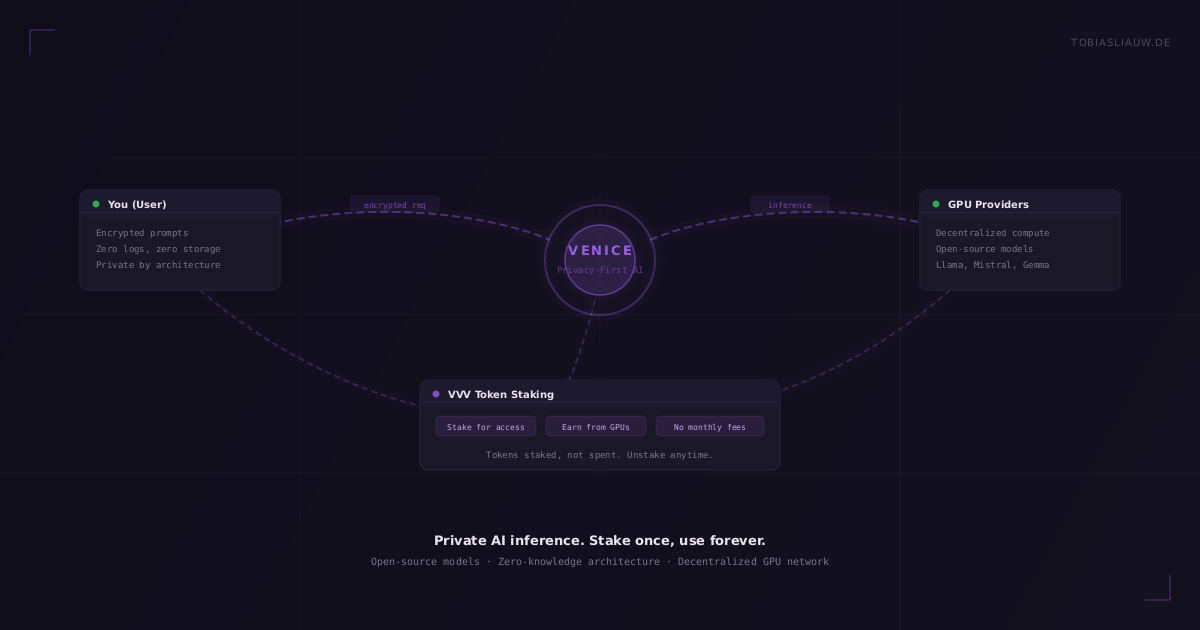
Venice runs open-source AI models (Llama, Mistral, and others) on GPU infrastructure, but with a zero-knowledge approach to user data. Your prompts are encrypted in transit, processed in memory, and discarded immediately after generating a response. There’s no prompt history on their servers, no conversation logs, no training data collection.
This isn’t just a privacy policy promise. The architecture is designed so that storing your data would require deliberate engineering effort, not the other way around. Most AI providers have to actively build systems to NOT store your data (and then you hope they actually do). Venice starts from zero storage and would have to build systems TO store it.
They run popular open-source models: Llama 3.1 (various sizes), Mistral, and others from the Hugging Face ecosystem. You get the same models you could run locally, but on serious GPU hardware that generates responses fast. The tradeoff compared to self-hosting is that you’re trusting Venice’s infrastructure instead of your own hardware, but you’re not trusting them with your data, which is a meaningful distinction.
The VVV Token: How It Actually Works
This is where it gets interesting from an infrastructure perspective. Venice isn’t just an AI service, it’s a decentralized AI network with its own token economics. The VVV token serves multiple purposes in the ecosystem:
Staking for Access
Instead of a traditional subscription model, Venice uses token staking. You acquire VVV tokens and stake them on the platform. The amount you stake determines your access tier: how many requests per day, which models you can use, and your priority in the queue during peak times. This is fundamentally different from paying a monthly fee because staking isn’t spending. Your tokens remain yours. You’re locking them up as collateral for access, but they’re not consumed. You can unstake and sell them whenever you want.
The practical effect is that your AI access has an upfront cost but zero ongoing cost. Stake once, use the API indefinitely. For someone like me who runs AI inference constantly across multiple projects, this model is significantly cheaper than per-token pricing over time.
Staking for GPU Providers
On the supply side, GPU operators can contribute their hardware to the Venice network and earn VVV tokens for processing inference requests. If you have spare GPU capacity (say, an RTX 3090 that’s idle 18 hours a day), you can run a Venice worker node and earn tokens proportional to the work your GPU does.
This creates a decentralized GPU marketplace where demand (users staking for access) and supply (GPU operators staking and providing compute) find equilibrium through the token price. More demand pushes the token price up, which incentivizes more GPU operators to join, which increases capacity, which stabilizes pricing. Classic supply/demand dynamics, but for AI compute.
Why This Model Makes Sense
The token model aligns incentives in a way that subscription pricing doesn’t:
- Users want cheap, private inference. Staking gives them that without recurring costs.
- GPU operators want consistent income. The network provides a steady stream of inference jobs.
- Venice (the platform) wants scale. The token mechanism bootstraps both supply and demand without requiring massive upfront capital for GPU procurement.
Compare this to the traditional model: OpenAI buys billions in GPUs, charges per token, and keeps all the margin. Venice decentralizes the GPU layer and lets the market price compute. Whether this is “better” depends on what you optimize for, but for privacy-conscious users who want predictable costs, it’s compelling.
Privacy-First Models: What That Means in Practice
Running open-source models is the foundation of the privacy claim. When you use GPT-4 or Claude, you’re using a proprietary model where you can’t verify what happens to your input. With open-source models like Llama 3.1, the model weights are public. Anyone can inspect the architecture, anyone can verify the model isn’t exfiltrating data, and anyone can run the same model on their own hardware to compare outputs.
Venice combines this with their zero-storage architecture to create a setup where:
- The model is open-source and auditable
- Your prompts are encrypted in transit
- Processing happens in memory only
- No conversation history is stored server-side
- No data is used for model fine-tuning
For use cases like processing business documents, writing internal communications, analyzing proprietary code, or handling customer data, this matters. Sending a client’s financial data to OpenAI’s API means trusting their data handling practices. Sending it to Venice means the data doesn’t persist anywhere outside your own systems.
How I Use It Alongside Self-Hosted AI
I run Ollama locally on my own GPU for most inference tasks. So why would I also use Venice? Different tools for different situations:
- Local (Ollama): Maximum privacy, zero latency overhead, but limited to models my hardware can run. A 7B-13B model on my RTX 3090 is fast, but a 70B model is too slow to be practical.
- Venice: Privacy-preserving but with access to larger models running on beefier hardware. When I need 70B-class performance with privacy guarantees, Venice fills the gap my home GPU can’t.
- Cloud APIs (OpenAI/Anthropic): Maximum capability (GPT-4, Claude Opus), but zero privacy. I use these for non-sensitive work where model quality matters more than data control.
The staking model means my Venice access doesn’t compete with my cloud API budget. The tokens are staked, not spent. My only ongoing cost is electricity for my home setup and per-token charges for the cloud APIs I choose to use. Venice sits in between as the “private but powerful” option.
The Risks and Open Questions
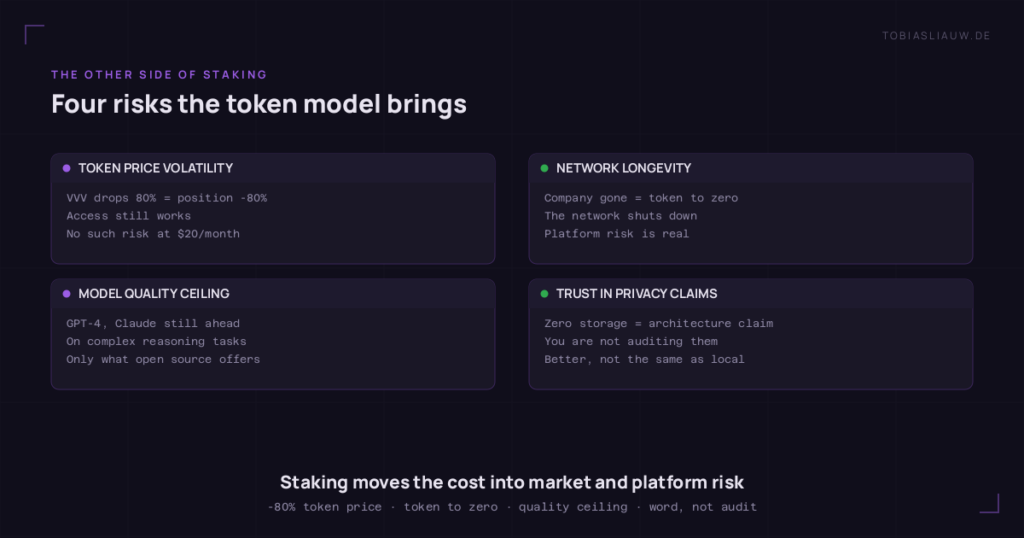
I’m not going to pretend this is all upside. Token-based models come with real risks:
- Token price volatility. If VVV drops 80%, your staked position is worth 80% less. Your AI access still works, but your capital is exposed to crypto market dynamics. This isn’t a risk with a $20/month subscription.
- Network longevity. If Venice the company goes away, the token goes to zero and the network shuts down. Decentralization is a spectrum, and Venice is still early enough that platform risk is real.
- Model quality ceiling. Open-source models are excellent and improving fast, but the frontier models (GPT-4, Claude) are still ahead for complex reasoning tasks. Venice can only serve what’s available in the open-source ecosystem.
- Trust in the privacy claims. “Zero storage” is an architecture claim. Unless you’re auditing their infrastructure (you’re not), you’re ultimately trusting their word, which is better than most providers, but not the same as running it yourself.
Who Should Care About This
If you’re a hobbyist running local models and you’re happy with the quality, Venice might not add much. Your home GPU is already the most private option.
But if you need access to larger models than your hardware supports, and you care about data privacy, Venice fills a real gap. It’s the middle ground between “run everything locally” and “send everything to OpenAI.” The token economics add a crypto dimension that isn’t for everyone, but the underlying service (private, open-source AI inference) is genuinely useful regardless of how you feel about tokens.
I’ll keep running my local Ollama setup as the primary inference path. Venice is the backup for when I need more horsepower with the same privacy expectations. And the staking model means I’m not burning money every month for that capability. It just sits there, ready when I need it.