Server management is stuck in a loop. We SSH into machines, run commands, check dashboards, SSH out. Or we use web panels that abstract away the machine but give us forms and buttons designed twenty years ago. Hosting panels like Plesk and cPanel solved the “make it clickable” problem but never solved the “make it intelligent” problem. They’re GUIs over shell commands, nothing more.
I’ve been building something different. ClawForge is an AI-native server management platform where the primary interface isn’t a dashboard or a terminal. It’s an agent that can see, reason, and act on your infrastructure the way a senior sysadmin would, but available at 3am when your pager goes off.
The Problem With Current Tooling
Every hosting panel, infrastructure dashboard, and monitoring tool shares the same fundamental design: they present data, and a human interprets it. CPU is at 94%? A human decides if that’s normal. Disk is filling up? A human figures out which logs to rotate. A deploy failed? A human reads the error, cross-references the config, and fixes it.
This worked when you had five servers. It breaks at fifty. It’s absurd at five hundred. The industry’s answer has been “more dashboards, more alerts, more runbooks.” Which means more human attention, which is the one resource that doesn’t scale.
The second problem is fragmentation. Managing a modern stack means switching between your hosting panel, your CI/CD dashboard, your monitoring tool, your log aggregator, your container registry, your DNS provider, and your SSL certificate manager. Each has its own interface, its own mental model, its own authentication. The cognitive overhead of context-switching between six tools to debug one issue is enormous.
What ClawForge Is
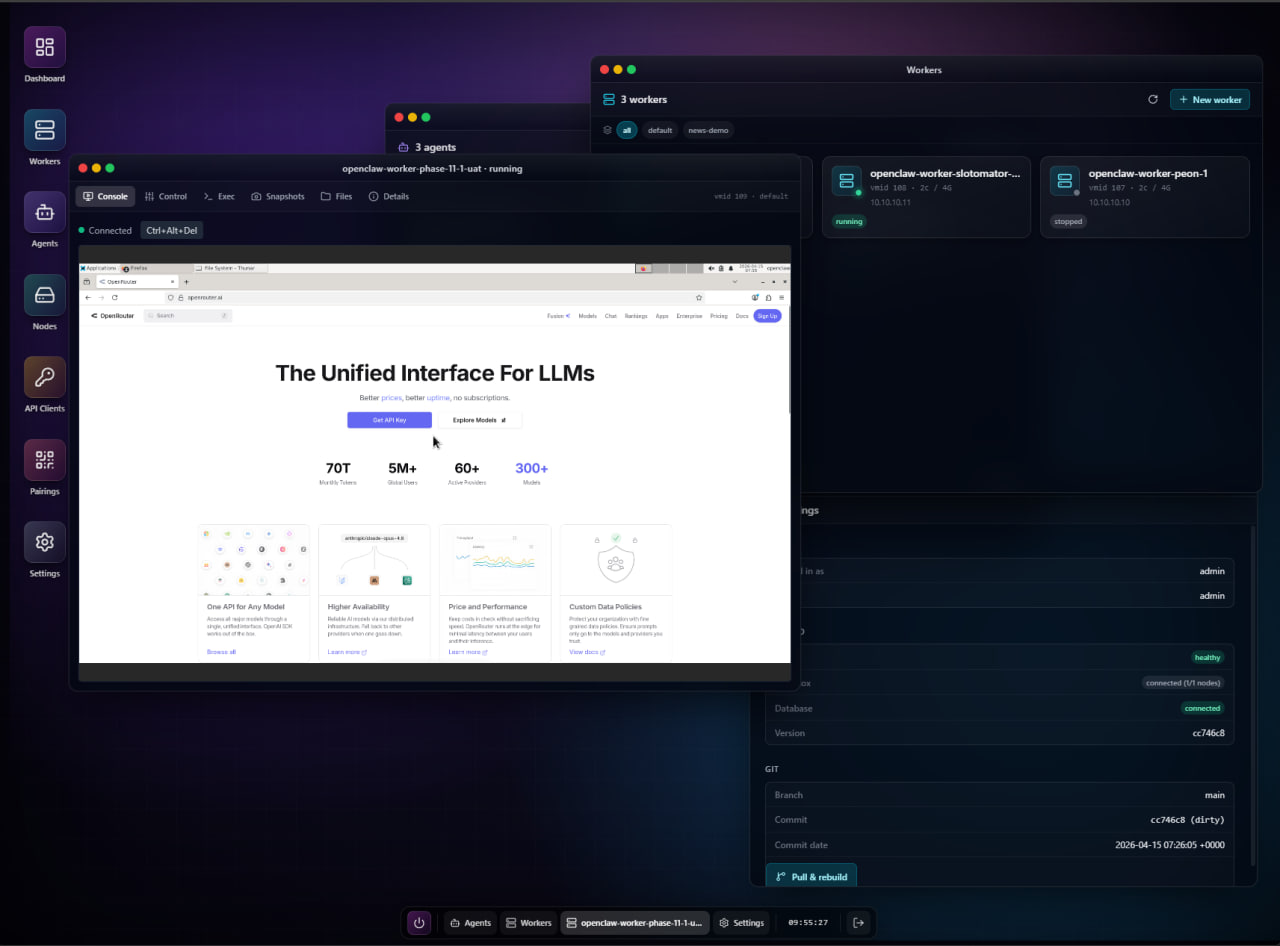
ClawForge is a platform that puts an AI agent between you and your infrastructure. Not a chatbot that generates shell commands for you to copy-paste. An agent with actual access: it can read your server state, execute commands, modify configurations, deploy code, and monitor the results. It operates inside an isolated cloud desktop environment with full browser, terminal, and file system access.
The core architecture:
- Isolated worker environments. Each management session runs in its own sandboxed container with a full Linux desktop. The agent has a real browser, a real terminal, real tools. It’s not simulating actions; it’s performing them in an environment identical to what a human would use.
- Visual understanding. The agent can take screenshots, identify UI elements, and interact with web-based management interfaces. This means it works with any existing tool, not just CLI-based ones. It can navigate your Proxmox dashboard, your Grafana panels, your CI pipeline interface.
- MCP (Model Context Protocol) bridge. External AI tools, including Claude Code, can connect to ClawForge workers and control them programmatically. This turns ClawForge into a backend that any AI agent can operate through.
- Snapshot and rollback. Before any potentially destructive operation, the agent snapshots the worker state. If something goes wrong, rollback is instant. This is the safety net that makes autonomous operations viable.
The Vision: AI-Native Infrastructure Management
Think about what a senior infrastructure engineer actually does. They don’t just run commands. They observe system state, form hypotheses, test them, make decisions based on context and experience, and verify results. They know that a spike in load at 2pm on a Tuesday is normal (the daily batch job) but at 2am is not. They know that “disk full” on the log partition means log rotation is broken, not that you need a bigger disk.
ClawForge is designed to replicate this reasoning loop, not just the command execution:
- Observe. The agent connects to your infrastructure, reads current state, checks metrics, reviews recent changes.
- Assess. Using both the current state and historical context (past incidents, known patterns, configuration baselines), it determines what needs attention.
- Plan. Before acting, it formulates a plan and, depending on your configured autonomy level, either executes it or presents it for approval.
- Act. It performs the operation in its sandboxed environment, with full visibility into what it’s doing at every step.
- Verify. After acting, it confirms the expected outcome. Did the service come back up? Did the deploy succeed? Are the metrics returning to normal?
Concrete Use Cases
This isn’t theoretical. Here are the workflows I’m building toward and partially running today:
Website Deployment and Management
Instead of configuring a web server through a panel, you describe what you want: “Deploy this repository as a PHP application with a MariaDB database, SSL certificate, and daily backups.” The agent provisions the vhost, configures the web server, sets up the database, installs SSL, configures the backup schedule, and verifies everything works. If the application has specific requirements (a particular PHP version, specific extensions, cron jobs), the agent reads the project’s configuration files and adapts.
When something breaks in production, you don’t dig through logs manually. You tell ClawForge “the site is returning 502 errors” and it investigates: checks the web server status, reads the error logs, identifies the upstream failure, and either fixes it or tells you exactly what’s wrong and what the options are.
Server Hardening and Security
Security hardening is tedious, repetitive, and critically important. It’s also exactly the kind of work an AI agent excels at: apply a known set of best practices, verify each one, report any deviations. ClawForge can audit a server against a security baseline (SSH configuration, firewall rules, package updates, service exposure, file permissions), apply remediations, and produce a compliance report. Not a one-time scan, but ongoing monitoring with automatic remediation for known-safe fixes.
Multi-Server Orchestration
The real power emerges with multiple servers. Rolling out a configuration change across a fleet means the agent connects to each machine, applies the change, verifies the result, and moves to the next. If one machine fails, it stops, reports the issue, and waits for guidance rather than blindly continuing. It understands that a failed apt upgrade on machine 3 of 20 means “stop and investigate,” not “retry and hope.”
Monitoring and Incident Response
Traditional monitoring tells you something is wrong. ClawForge investigates why. When an alert fires, the agent can immediately begin the diagnostic process a human would follow: check the service status, review recent deployments, examine resource utilization, read relevant logs, and correlate across systems. By the time you look at the incident, it’s already triaged with a probable cause and suggested resolution.
Why Not Just Use Ansible/Terraform/Pulumi?
Infrastructure-as-code tools are excellent at what they do: defining desired state and converging toward it. ClawForge isn’t replacing them. It’s the layer above.
Ansible can apply a playbook. It can’t decide which playbook to run based on a vague problem description. Terraform can provision infrastructure. It can’t diagnose why the infrastructure it provisioned is misbehaving. These tools encode human decisions into automation. ClawForge is about making more of those decisions autonomously.
In practice, ClawForge will use tools like Ansible and Terraform as its hands. The agent writes the playbook, runs it, and verifies the result. The intelligence is in the decision-making, not the execution.
The Backend Architecture
ClawForge runs on a simple but deliberate stack:
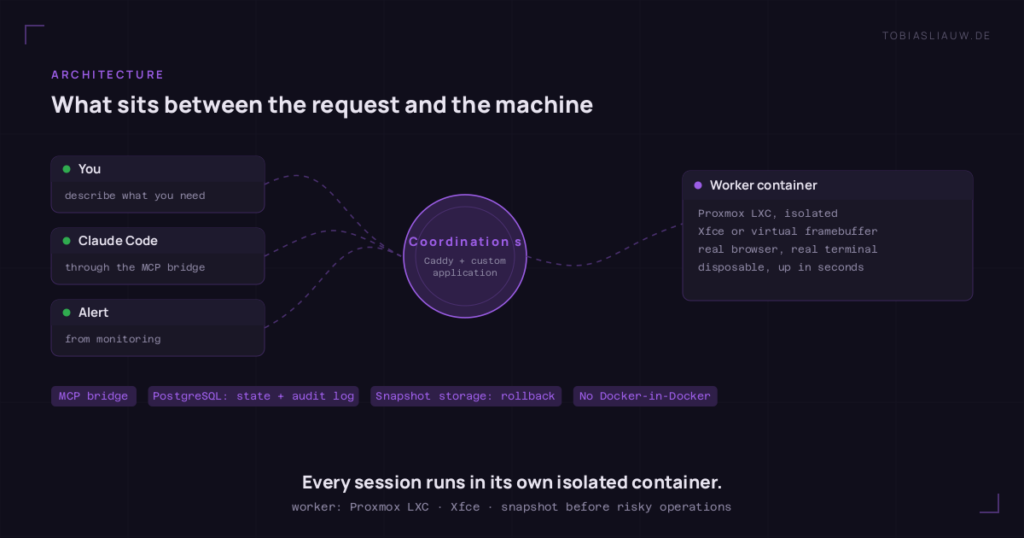
- Worker containers based on lightweight Linux images with a full desktop environment (Xfce or headless with virtual framebuffer). Each worker is isolated and disposable.
- A coordination service (Caddy + custom application) that manages worker lifecycle, authentication, and routing.
- An MCP bridge that exposes worker capabilities to external AI agents. This is the integration point: any MCP-compatible AI tool can connect to a ClawForge worker and use it as a compute environment.
- PostgreSQL for state management, audit logging, and session history.
- Snapshot storage for worker state preservation and rollback.
The workers themselves run on Proxmox LXC containers, which gives us the isolation guarantees of containers with the performance characteristics of near-bare-metal execution. No Docker-in-Docker nesting, no Kubernetes complexity. Just lightweight containers that spin up in seconds and cost almost nothing when idle.
What “Backend for Websites” Actually Means
The ambitious vision is this: ClawForge becomes the management backend for web infrastructure the way a hosting panel is today, but intelligent. Instead of clicking through forms to create a site, you describe what you need. Instead of reading documentation to configure a complex setup, you explain the requirements and the agent implements them.
For web agencies managing dozens of client sites, this changes the operating model. A single engineer with ClawForge can manage infrastructure that currently requires a team. Not because the tool does simple things faster, but because it handles the complex, context-dependent work that previously required senior-level expertise for every decision.
The roadmap:
- Phase 1 (current): Single-worker management sessions. Connect to a server, perform tasks, disconnect. The agent as a skilled pair of hands.
- Phase 2: Persistent server connections with ongoing monitoring. The agent maintains awareness of your infrastructure state between sessions.
- Phase 3: Multi-server orchestration with policy-based autonomy. Define what the agent can do without approval (restart a crashed service) vs. what needs human sign-off (modify a production database).
- Phase 4: Full infrastructure lifecycle management. Provisioning, deployment, scaling, incident response, and decommissioning, all through a conversational interface backed by real execution capabilities.
The Bet
The bet behind ClawForge is simple: the hosting panel as a product category is about to be disrupted. Not by a better panel with a nicer UI, but by a fundamentally different interaction model where the AI agent is the primary operator and the human is the supervisor. The panel doesn’t need better buttons. It needs to stop being a panel.
Every week, the underlying AI models get better at reasoning, tool use, and multi-step planning. The gap between “agent that can click buttons in a simulated environment” and “agent that can manage production infrastructure” is closing faster than most people in the hosting industry realize. ClawForge is being built to be ready when that gap closes completely.
I’ll be sharing technical deep-dives on the MCP bridge, the worker architecture, and specific automation workflows as the platform develops. If you’re managing infrastructure and tired of the current tooling paradigm, this is the space to watch.